“Another Sensational Discovery Shakes the Art World” (E17)

  • Originally printed: The New Yorker, August 16, 1930
  • First reprinted in: Never reprinted
  • Original Byline: Robert Benchley

🦉🦉🦉

Comments:
Here RB intervenes in the fashionable furor over forgery and false fronts in the fine arts, as seen in such keen sociological treatises as Animal Crackers. The piece parses out the purport of an allegorical stag hunt substratum reprieved from obscurity by an overzealous museum cleaner, whose critical scrubbing skills helped put a phony Rembrandt-Romney to rout (and to rinse). Who could have guessed that old George Romney (the portraitist, not his descendant the Mitt-maker) had concealed such medievalist mental states beneath his staid social miming stocks in trade?

Knowing that such flights of feudal fantasy didn’t pay the bills during the Age of Enlightenment, the ambitious Romney apparently thought so little of his creation that he scrupled not at scribbling the odd commercial calculation or dalliance digits across its bestiological bottom half. And leave it to Benchley to get in a cheep cheep cheep shot at his avian enemies along the way!

Favourite Moment:
“To carry the stag-hunt story down into the foreground, where the dolphin and the lion are, would seem to be folly. They seem to be part of another idea entirely.”

“Announcing a New Vitamin” (E16)

  • Originally printed: Liberty Magazine, September 12, 1931
  • First reprinted in: No Poems; Or, Around the World Backwards and Sideways
  • Unable to compare reprint with original text – Liberty Historical Archives not available at Toronto Public Library
  • Original Byline: unknown

🦉🦉🦉

Comments:

Writing in the persona of an introspective nutritional ballyhoo man, RB details the trials and deliberations of researchers who isolate a compound with very little get-up-and-go-to-market potential. Stumbling upon their discovery while picking through a mess of mackerel bones, Dr. Arthur W. Meexus and the author congratulate each other on shoring up the inexcusable gap between Vitamins E and G (later demoted to second-class status as Vitamin B2). The pair’s mirth dissipates when they realize that all of the really good dietary claims have been staked by their alphabetical antecedents. What’s left for Vitamin F?


Groping about for some slogan-ready boon in their breakthrough, RB and Meexus try a few biological jingles on for size. Saliva anyone? How about a little top-up for your tear ducts? Perhaps a dash of grotesque anthropology might make the masses F-conscious? No scientist worth their salt (or milk, or radishes, or cod liver oil) is going to yoke their lab’s prestige to such a lemon (lemon? that’s Vitamin C – a good vitamin!) The thing begins to seem a little desperate, and our author wisely considers tossing Vitamin F back on the bone heap.

Favourite Moment:
“We have announced [Vitamin F’s] discovery and have given to the world sufficient data to show that it is an item of diet which undoubtedly serves a purpose. But what purpose? We are working on that now, and ought to have something very interesting to report in a short time. If we aren’t able to, we shall have to call vitamin F in, and begin all over again.”

“Anatol Revisited: The Devious Ways of a Man With a Maid, in the Present Servant Market” (E15)

  • Originally Published: Vanity Fair, November 1919
  • First Reprinted: Never reprinted
  • Original Byline: Robert C. Benchley, with a slight nod to Mr. Schnitzler

🦉🦉🦉

Comments:
A spoof of Arthur Schnitzler’s Anatol, transplanting the Viennese play’s vexed quest for perfectly reciprocated love under patriarchy into the more prosaic (but equally impossible, by definition) task of attracting unalientated help around the kitchen. In the original, Schnitzler’s callow lothario heads off his own hedonism at every turn by faint-heartedly fixating on questions that he does not really want answered – i.e. do the objects of his feeble flirtations feel an all-consuming passion for him?


Frustrated by an unprecedentedly tight New York servant market, Benchley’s Anatol doesn’t even get that far in his financialized philandering, failing to get a single domestic conquest across the threshhold of his country estate. Unaccustomed to the short end of the negotiating stick, the would-be employer finds himself unable to satisfy any of his prospective pick-ups, despite eventually going so far as to suggest that he will explore the possibility of rearranging the solar system as part of the benefits package.


Brilliant in conception, the piece doesn’t quite live up to its potential on the page, but thought-provoking stuff, nevertheless.

Favourite Moment:
“Why should you face the east? And even if it [the servant’s room] did, we could easily change it… I mean the sun doesn’t have to rise in the east, does it? … I know it always has, – but, my God, Agnes, I can’t lose you now!… Something can be done… Something must be done!”

“America’s Greatest Movement: The Jaw Movement” (E14)

“America’s Greatest Movement: The Jaw Movement” (E14)
Originally Published: World Outlook, October 1916
First Reprinted: Never reprinted
Byline: Robert C. Benchley

🦉🦉

Comments:
A true oddity in the Benchley canon, in that it seems to be almost entirely about what it purports to be about, earnestly chewing over a set of facts filtered through the quaint, by 1916, lens of Victorian liberal free trade philosophy. There are glimmers of the author’s sense of humour in the introductory and concluding sections, but for the majority of its length, this article really does aim to communicate historical and economic information about chicle, the basic ingredient in chewing gum (until it was replaced by cheaper, synthetic materials during the middle of the century).

Printed soon after Wilson-Villa era tensions along America’s southern border reached their boiling point (US army “punitive raids” occurred throughout the spring and summer of 1916), the piece warns against any actions that might disarrange the “entente cordiale” between central American chicle gatherers, U.S. manufacturers and their millions of peacefully masticating customers. Most of this sincere tone is undoubtedly an artifact of the unusual publication venue – World Outlook was a typeset creature of the Board of Foreign Missions of the Methodist Episcopal Church – however, as every Benchley aficionado knows, there was an extremely earnest side to this genial exponent of absurdity and apostle of fair play in facetiousness. Presumably, the same impulse which led RCB to consider devoting his life to social work also allowed his journalistic muse to vibrate in tune with a magazine written by and for progressive clergymen; if only, thankfully, this once.

Favourite Moment:
“Thus it is that Mexico and the United States are joined by ties that transcend diplomacy, and woe to the Administration or the Opposition through whose machinations the supply of chewing-gum is cut off and the bulwark of our Democracy shattered.”

“All Up For ‘Citizenship Day’” (E13)

  • Originally Published: Life Magazine, October 26, 1922
  • First Reprinted: Never reprinted
  • Original Byline: R.C.B.

🦉🦉

Comments:
Even the Apostle of Applesauce had his limits, and RB reaches his in contemplating the proposed advent of yet another Patriotic Holiday. This little Battle Ahem of the Republic suffers greatly from its attempt to confront the abyssal absurdities of American Civic Religion head on. With the gaudy austerities of the roaring twenties in full swing and the tumorous open secret of Jim Crow lynch law pressing heavily upon the nation’s frontal lobe, ol’ Uncle Sam’s huzzah-haunted hypocrisy was just too big to foil at this time (one can only hope the condition isn’t permanent). Benchley’s targets are too self-evident and too painfully unassailable; and his mock allegorical floats of fancy never leave the ground.


On a brighter note, “Citizenship Day” did fail to reach red letter day status on November 4, 1922 – a fizzle RB must have drunk to. However, the concept did eventually gain country-wide traction, metastasizing into Pact With Hell and Covenant With Death (aka Constitution) Day.

Favourite Moment:
“At the other end [of an allegorical float representing the Dignity of the Law] is shown New York City enforcing the Prohibition laws. Someone seems to be accepting money from someone else in this group, but you can’t quite make out who the parties are.”

“All About the Silesian Problem” (E12)

  • Originally Published: Syndicated Piece, News Publishing Co. (spotted in the Oakland Tribune and The Charlotte News, among other outlets), August 14, 1921
  • First Reprinted: Love Conquers All
  • Original Byline: Robert C. Benchley

🦉🦉🦉🦉🦉

Comments:
Nearly 20 years before Silesia became a flashpoint in Hitler’s monstrous Anschluss aggressions, Benchley subjects East-Central Europe’s ruling classes to a whimsically withering historical inquiry. Mocking the practice of dignifying dizzyingly stupid aristocratic and irredentist spats with naming conventions derived from mathematics, RB proposes a novel answer to the “Silesian Question.”


“No.”


Describing a series of political production numbers scarcely less absurd than the Habsburg Vanities and the Polish Partition Follies of 1772, 1793, and 1795, RB takes the reader on a mellifluously mad journey into the heart of anti-democratic darkness. I refer here, of course, to the epochal Summoning of the Storkrath, where the political will of the Duchy’s assembled nobles, welterweights and licensed pilots coalesced around a policy of strict indifference (at best) to the actual needs of everyone else in Silesia.

Favourite Moment:
“And he was the kind of man who would stop at nothing when it pleased him to augment his duchy.”

Reprint Notes:

  • Topical reference to France and England “splitting” over the Silesian problem has been removed from the version in Love Conquers All. Presumably they got over it.
  • Title in The Charlotte News: “Silesian Problem Clear”
  • Title in the Oakland Tribune: “Silesia Row is Explained By Benchley”

“All About Relativity: Einstein’s Theory Explained for The Lay-Mind in Simple Terms” (E11)

  • Originally Published: Vanity Fair, March 1920
  • First Reprinted: Never
  • Original Byline: Robert C. Benchley

🦉🦉🦉

Comments:
Nothing earth-shattering here, as Benchley bends Einstein’s bolts from the blackness of space into a set of light goofs on gravity. RB mocks the incongruously chummy obscurantism that characterizes so much popular scientific discourse, laying a miserable crumb trail of the theory’s most easily digestible minutiae that leads absolutely nowhere. Promising to open up a worm hole between the lay reader’s mind and the core concepts of cutting-edge 20th century physics, RB then tosses the low hanging fruit of his obtuse inquiry aside without so much as an existential frisson. The author’s quarrel is not with Einstein, or with any of his fellow pioneers in the vanguard of space-time research, but rather with the newspaper and magazine hacks who come off like the half-assed evangels of a new cosmic theory whose power to illuminate never glimmers onto the page.


Published a couple of months after Benchley’s resignation from Vanity Fair in protest against the dismissal of Dorothy Parker and Robert Sherwood, this could very well be the erstwhile Managing Editor’s final piece for the magazine (I guess I won’t know that for sure until I complete my alphabetical survey). If so, he went out on a fittingly futile note.

Favourite Moment:
“When the professors have got this far in their explanation of Einstein’s Theory, they say that, of course, the whole thing is difficult to explain to the lay-mind, and that the best and most loyal thing to do is simply to take the scientists’ word for it and let it go at that.”

“Agenda” (E10)

  • Originally printed: The New Yorker, February 8, 1930
  • First reprinted in: Never Reprinted (for all practical purposes)
  • Original Byline: Guy Fawkes

🦉🦉🦉

Commentary:
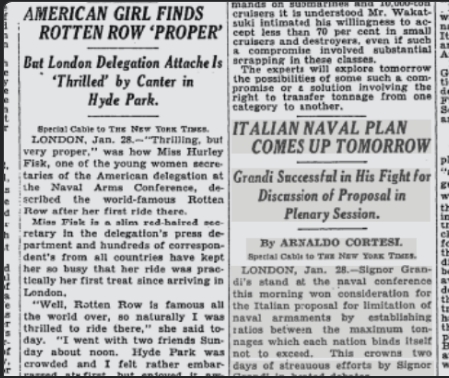
Writing as Guy Fawkes, RB notes the failure of the London Naval Conference to make waves commensurate with the attention paid to it. Correctly identifying this supposed sea lane to everlasting world peace as yet another smug salvo in the USA and UK’s effort to maintain maritime supremacy at discount prices, the author chides the New York papers for sending half their collective staffs across the pond just to make wild, quasi-official-sounding guesses at the kinds of terms the talks might produce. Less dangerously, but more obnoxiously, the media’s thirst for naval-tinged news had led to the publication of pieces like the NY Times item clipped above, in which conference secretarial staff member Hurley Fisk’s impressions of London greenspaces were deemed page 3-worthy.


Fawkes looks more favorably upon The World’s deadpan daily dispatches from a Conference clearly headed nowhere, and not even nowhere fast. Nevertheless, with hundreds of pages to fill every day, the city’s sheets couldn’t help but cover a few matters of actual import. The Hearst papers, we hear, actually bucked the transatlantic trend, preferring to spotlight a home front hot war between telephone service providers. More civic mindedly, The Telegram took Harvard College to task over its vile treatment of its custodial workers, and The World did its best to tamp down the NYPD’s truncheons in its true blue zeal to take capital’s side against “reds”.


On the other hand, The World also appeared to be developing a very bad habit of printing their front page headlines verbatim from various Hollywood studio publicity dispatches – and the soon-to-be-defunct paper baffled Benchley by “revealing” that poet Edna St. Vincent Millay had once published articles under the pseudonym Nancy Boyd, about 5 years after the last person who cared about this transparent literary imposture had forgotten all about it.

Favourite moment:
“The big excitement in the newspaper offices during the past month has been the Naval Conference in London. The excitement did not spread. [NYC Fire] Chief Kenlon, at a late hour last night, gave out the statement that it was now confined to a small corner of the newspaper offices and that, by tomorrow, the department expects to have the whole thing out and wet down.”

“After 3 A.M.” (E9)

  • Originally printed: The New Yorker, July 17, 1926
  • First reprinted in: Never Reprinted
  • Original Byline: Robert Benchley

🦉🦉

Commentary:
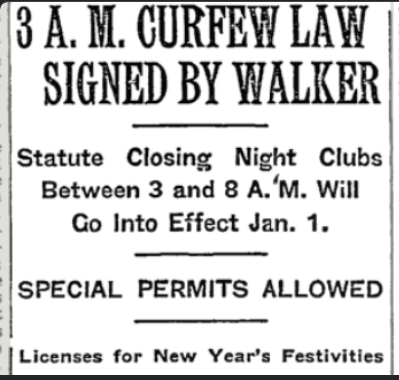
A rather slight half-page piece mocking a municipal law proposed by the Walker administration. The ordinance did in fact make it onto the books for 1927 (see below Times clipping), so Benchley’s screwball itinerary for New Yorkers who have no intention of going home until the office buildings open may very well have come in handy. For nocturnal New Yorkers bent on making their own pre-auroral fun, there was always the Columbia Storage Warehouse, the Weather Bureau station overlooking the Battery, the Eleventh Avenue steam train, and the Aquarium. Only dullards and out of towners turn in at three, in spite of Jimmy Walker’s machinations!

Favourite moment:
“Here [the weather station] there is fun indeed for all! The charts, the indicators, the thermometers and barometers, all conspire to keep guests in a fever of excitement until the little hand on the chronometer indicates that dawn is approaching.”


“After the Deluge” (E8)

  • Originally printed: The New Yorker, March 25, 1933
  • First reprinted in: Never Reprinted (for practical purposes)
  • Original Byline: Guy Fawkes

🦉🦉🦉🦉

Commentary:
Writing in his Guy Fawkes persona, RB catches up with the New York papers as they struggle (and fail) to produce coherent coverage of the Banking Crisis of March 1933, often described (in retrospect) as the absolute nadir of the Depression.


The piece begins with a blanket statement on the Press’s subservient role vis-à-vis the government. This was all well and good, Fawkes says, from the point of view of efficiency, during the summer of 1917, when the Wilson government knew exactly what they wanted in the headlines (and what they’d throw you in jail for saying against the War Effort). When Robert Benchley references the July 4th holiday (the day the family learned that beloved eldest son Edmund had been killed in the Spanish-American War), you know he’s got some skin in the game… and when he yokes those comments to militaristic misadventures, you know he’s boiling! So… the Press stands ready to reinforce norms and manufacture consent, but what happens when the patriotic puppeteers lose the plot? During the first few days of March, the New York papers were presenting financial ruin as a minor problem affecting OTHER states (and the middle strata of the newspaper). Certainly nothing to get up a headline about.


Roosevelt’s March 4th inauguration, and the passage of the Emergency Banking Act, triggered a truly dizzying week of pronouncements and retractions from all of the city’s most trusted organs. Without any point of view to sell, these ink merchants opted for perpetual motion in lieu of “spin”. Hey, it helps to calm babies. Ultimately, Fawkes concludes, the city’s opinion leaders may have meant well, but there’s no way they did any good. He adds: “It might have been well if they had placed a moratorium on newspapers during that crucial period.”


The lengthy column goes on to ask whether the press will come down on “FR” or “FD” as their shorthand term for Franklin Delano Roosevelt (apparently no one had yet thought to go “TR” one letter better – but this would come shortly!) Fawkes also glances across the ocean to take in the London Daily Express’ errant coverage of February’s abortive pre-inauguration assassination attempt. The Express appears to have gotten the wrong Florida woman on the phone and then just allowed her to take solo credit for saving FDR’s life. He hopes a similar mistake in a more sensitive matter of international diplomacy won’t create a transatlantic incident someday. Finally, Fawkes tosses a rare bouquet the New York Times’ way for sending a competent progressive reporter to cover the ongoing travesty of the Scottsboro trials – and from a quick perusal of the copy he sent back, F. Raymond Daniell does appear to have done his best to ensure that justice was properly served (of course, that would have to wait until 2013).


Despite a lifelong love of Benchley’s humour, I had actually never read a Wayward Press column before. Terrific stuff – really looking forward to the rest of them!

Favourite Moment:

“What acute stage was that? What Depression? Certainly not the ‘protective action’ in roughly two thirds of the country’s banks announced on page 19?”