“All About Relativity: Einstein’s Theory Explained for The Lay-Mind in Simple Terms” (E11)

  • Originally Published: Vanity Fair, March 1920
  • First Reprinted: Never
  • Original Byline: Robert C. Benchley

🦉🦉🦉

Comments:
Nothing earth-shattering here, as Benchley bends Einstein’s bolts from the blackness of space into a set of light goofs on gravity. RB mocks the incongruously chummy obscurantism that characterizes so much popular scientific discourse, laying a miserable crumb trail of the theory’s most easily digestible minutiae that leads absolutely nowhere. Promising to open up a worm hole between the lay reader’s mind and the core concepts of cutting-edge 20th century physics, RB then tosses the low hanging fruit of his obtuse inquiry aside without so much as an existential frisson. The author’s quarrel is not with Einstein, or with any of his fellow pioneers in the vanguard of space-time research, but rather with the newspaper and magazine hacks who come off like the half-assed evangels of a new cosmic theory whose power to illuminate never glimmers onto the page.


Published a couple of months after Benchley’s resignation from Vanity Fair in protest against the dismissal of Dorothy Parker and Robert Sherwood, this could very well be the erstwhile Managing Editor’s final piece for the magazine (I guess I won’t know that for sure until I complete my alphabetical survey). If so, he went out on a fittingly futile note.

Favourite Moment:
“When the professors have got this far in their explanation of Einstein’s Theory, they say that, of course, the whole thing is difficult to explain to the lay-mind, and that the best and most loyal thing to do is simply to take the scientists’ word for it and let it go at that.”
“Agenda” (E10)

  • Originally printed: The New Yorker, February 8, 1930
  • First reprinted in: Never Reprinted (for all practical purposes)
  • Original Byline: Guy Fawkes

🦉🦉🦉

Commentary:
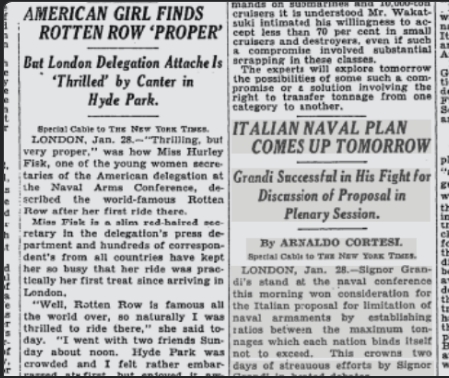
Writing as Guy Fawkes, RB notes the failure of the London Naval Conference to make waves commensurate with the attention paid to it. Correctly identifying this supposed sea lane to everlasting world peace as yet another smug salvo in the USA and UK’s effort to maintain maritime supremacy at discount prices, the author chides the New York papers for sending half their collective staffs across the pond just to make wild, quasi-official-sounding guesses at the kinds of terms the talks might produce. Less dangerously, but more obnoxiously, the media’s thirst for naval-tinged news had led to the publication of pieces like the NY Times item clipped above, in which conference secretarial staff member Hurley Fisk’s impressions of London greenspaces were deemed page 3-worthy.


Fawkes looks more favorably upon The World’s deadpan daily dispatches from a Conference clearly headed nowhere, and not even nowhere fast. Nevertheless, with hundreds of pages to fill every day, the city’s sheets couldn’t help but cover a few matters of actual import. The Hearst papers, we hear, actually bucked the transatlantic trend, preferring to spotlight a home front hot war between telephone service providers. More civic mindedly, The Telegram took Harvard College to task over its vile treatment of its custodial workers, and The World did its best to tamp down the NYPD’s truncheons in its true blue zeal to take capital’s side against “reds”.


On the other hand, The World also appeared to be developing a very bad habit of printing their front page headlines verbatim from various Hollywood studio publicity dispatches – and the soon-to-be-defunct paper baffled Benchley by “revealing” that poet Edna St. Vincent Millay had once published articles under the pseudonym Nancy Boyd, about 5 years after the last person who cared about this transparent literary imposture had forgotten all about it.

Favourite moment:
“The big excitement in the newspaper offices during the past month has been the Naval Conference in London. The excitement did not spread. [NYC Fire] Chief Kenlon, at a late hour last night, gave out the statement that it was now confined to a small corner of the newspaper offices and that, by tomorrow, the department expects to have the whole thing out and wet down.”

“After 3 A.M.” (E9)

  • Originally printed: The New Yorker, July 17, 1926
  • First reprinted in: Never Reprinted
  • Original Byline: Robert Benchley

🦉🦉

Commentary:
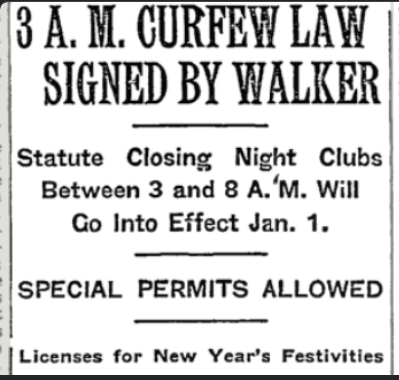
A rather slight half-page piece mocking a municipal law proposed by the Walker administration. The ordinance did in fact make it onto the books for 1927 (see below Times clipping), so Benchley’s screwball itinerary for New Yorkers who have no intention of going home until the office buildings open may very well have come in handy. For nocturnal New Yorkers bent on making their own pre-auroral fun, there was always the Columbia Storage Warehouse, the Weather Bureau station overlooking the Battery, the Eleventh Avenue steam train, and the Aquarium. Only dullards and out of towners turn in at three, in spite of Jimmy Walker’s machinations!

Favourite moment:
“Here [the weather station] there is fun indeed for all! The charts, the indicators, the thermometers and barometers, all conspire to keep guests in a fever of excitement until the little hand on the chronometer indicates that dawn is approaching.”


“After the Deluge” (E8)

  • Originally printed: The New Yorker, March 25, 1933
  • First reprinted in: Never Reprinted (for practical purposes)
  • Original Byline: Guy Fawkes

🦉🦉🦉🦉

Commentary:
Writing in his Guy Fawkes persona, RB catches up with the New York papers as they struggle (and fail) to produce coherent coverage of the Banking Crisis of March 1933, often described (in retrospect) as the absolute nadir of the Depression.


The piece begins with a blanket statement on the Press’s subservient role vis-à-vis the government. This was all well and good, Fawkes says, from the point of view of efficiency, during the summer of 1917, when the Wilson government knew exactly what they wanted in the headlines (and what they’d throw you in jail for saying against the War Effort). When Robert Benchley references the July 4th holiday (the day the family learned that beloved eldest son Edmund had been killed in the Spanish-American War), you know he’s got some skin in the game… and when he yokes those comments to militaristic misadventures, you know he’s boiling! So… the Press stands ready to reinforce norms and manufacture consent, but what happens when the patriotic puppeteers lose the plot? During the first few days of March, the New York papers were presenting financial ruin as a minor problem affecting OTHER states (and the middle strata of the newspaper). Certainly nothing to get up a headline about.


Roosevelt’s March 4th inauguration, and the passage of the Emergency Banking Act, triggered a truly dizzying week of pronouncements and retractions from all of the city’s most trusted organs. Without any point of view to sell, these ink merchants opted for perpetual motion in lieu of “spin”. Hey, it helps to calm babies. Ultimately, Fawkes concludes, the city’s opinion leaders may have meant well, but there’s no way they did any good. He adds: “It might have been well if they had placed a moratorium on newspapers during that crucial period.”


The lengthy column goes on to ask whether the press will come down on “FR” or “FD” as their shorthand term for Franklin Delano Roosevelt (apparently no one had yet thought to go “TR” one letter better – but this would come shortly!) Fawkes also glances across the ocean to take in the London Daily Express’ errant coverage of February’s abortive pre-inauguration assassination attempt. The Express appears to have gotten the wrong Florida woman on the phone and then just allowed her to take solo credit for saving FDR’s life. He hopes a similar mistake in a more sensitive matter of international diplomacy won’t create a transatlantic incident someday. Finally, Fawkes tosses a rare bouquet the New York Times’ way for sending a competent progressive reporter to cover the ongoing travesty of the Scottsboro trials – and from a quick perusal of the copy he sent back, F. Raymond Daniell does appear to have done his best to ensure that justice was properly served (of course, that would have to wait until 2013).


Despite a lifelong love of Benchley’s humour, I had actually never read a Wayward Press column before. Terrific stuff – really looking forward to the rest of them!

Favourite Moment:

“What acute stage was that? What Depression? Certainly not the ‘protective action’ in roughly two thirds of the country’s banks announced on page 19?”

“After-Bedtime Stories: How Lillian Mosquito Projects Her Voice” (E7)

  • Originally printed: Life Magazine, July 29, 1920
  • First reprinted in: Love Conquers All
  • Original Byline: Robert C. Benchley

🦉🦉🦉

Commentary:
Here, the nursery’s caustic conch passes from humanity’s best friend (E6) to one of its most implacable foes, in the anthropomorphized person of Lillian Mosquito. Nothing terribly surprising in RB’s characterization of the despised insect as motivated more by bloody-mindedness than by blood-lust. Lillian is a vampiric ventriloquist, baiting her inept victims to add insulting self-injury to their itches. More interestingly, perhaps, the piece expands upon the previous installment’s note of malaise under Mother Nature’s malevolent tutelage. A shame we never got to learn “how Lois Hen scratches up the beets and Swiss chard in gentlemen’s gardens…”

Favourite moment:
“But he was prevented from leaving by kindly Old Mother Nature, who stepped on him with her kindly old heel…”

Reprint Note:

  • Reprinted under the title “Animal Stories: Part II – Lillian Mosquito”

“After-Bedtime Stories: How Georgie Dog Gets the Rubbers on the Guest Room Bed” (E6)

  • Originally printed: Life Magazine, July 15, 1920
  • First reprinted in: Love Conquers All
  • Original Byline: Robert C. Benchley

🦉🦉🦉

Commentary:
Reprinted in Love Conquers All as part of a diptych with E7 (“How Lillian Mosquito Projects Her Voice”), we embark on a little field trip to Old Mother Nature’s nursery, where anthropomorphic auditors gather each day for a series of seminars in mischief making. Georgie Dog relates with relish his best practices for doing one’s worst with sodden footwear. A perverse peek at the author’s proto-sitcom universe from the perspective of the kind of domestic chaos agent so apt to addle the Benchleyan Little Man’s intimations of harmony.

Favourite moment:
“And sure enough, in came Georgie Dog, wagging his entire torso in a paroxysm of camaraderie, even though everyone knew that he had no use for Waldo Lizard.”

Reprint Notes:

  • Title changed to “Animal Stories: Part I – Georgie Dog”
  • Cartoon of Georgie not reprinted in Love Conquers All – not by Gluyas Williams

“Advice To Investors” (E5)

  • Originally printed: DAC News (unknown date – presumably 1924/1925)
  • First reprinted in: Pluck and Luck
  • Original Byline: Robert C. Benchley

🦉🦉🦉🦉

Commentary:
Absolutely inspired nonsense from Benchley, drawing nitrous oxide suffused breath from the basic babblings of the business page. Diligent research has now (and I mean just now!) disclosed that the piece first appeared (under a different title) in an as-yet-unknown issue of that Executive’s Delight, the Detroit Athletic Club News, which just makes me love it all the more. Who said America’s Capitalist Leaders don’t have a sense of humour about their role in the nation’s affairs? We can be pretty sure of our rough date for the article, at least, thanks to its speculative engagement with the true meaning of the 1924 Presidential Election (it had none). Boom and bust a gut economics at its finest!

Favourite moment:
“Europe’s plight has not been without its influence either. Europe’s plight is never without its significance. No matter what you are figuring on doing, you must count on Europe’s plight to furnish at least fifty percent of the significance and ten percent of the gross.”

Reprint Note:

  • Originally appeared in the DAC News under the title “Our Monthly Market Letter”
  • Gordon E. Ernst, Jr.’s Annotated Bibliography lists the essay under the reprinted title, as the original could not be identified using the resources available in 1995

“Advice To Gangsters” (E4)

  • Originally printed: Unknown (presumably the roaring twenties)
  • First reprinted in: Chips Off the Old Benchley
  • Original Byline: Unknown

🦉🦉🦉

Commentary:
A piece of unknown provenance selected by Gertrude Benchley for inclusion in the posthumously issued Chips Off the Old Benchley (1949). With apparently topical references to bootlegging and tommy guns, it must have been composed during Prohibition – but when? And for what brave periodical? If Gordon E. Ernst, Jr. doesn’t know, none of us dilettantes are likely to prise the secret from the arthritic jaws of lost time. Our author boldly enjoins the nation’s criminals to knock off knocking each other off and begin working together toward some worthwhile common goal – like improving the quality of liquor on offer. RB deplores the wasted materiel and man hours invested in all of these madcap massacres, when any illicit imbiber knows there is real work to be done on the production end of the business. Inspired no doubt by an abject cowardice RB is only too eager to own up to, the piece abandons its trenchant critique somewhere around page 3 in favour of a few homiletic lessons in limited boy gang warfare learned on the snowball strewn streets of turn-of-the-century Worcester, Mass.

Favourite moment:
“A man can’t buy a good glass of beer for his little boy today without having the fear that the child will be going around the house all the next day moaning and holding onto its head and snapping at its parents.”

“Accustomed As I Am–” (E3)

  • Originally printed: Liberty Magazine, October 18, 1930
  • First reprinted in: Benchley Lost and Found
  • Unable to compare reprint with original text – Liberty Historical Archives not available at Toronto Public Library
  • Original Byline: unknown

🦉🦉🦉

Commentary:
Here we find RB in the grip of a signature frustration – his inability to get the last word in a confrontation with an appreciative, uncomprehending audience. The piece begins and ends with our narrator exulting in his near escape from the toastmaster racket. Incorporating bits of Benchleyan biographical detail, the speaker chronicles his first taste of after dinner agony as a society reporter forced to witness the witless in their business class habitat. Seeking to put a stake in this appalling rite, RB prepares his own bourgeois burlesques – and finds himself a stakeholder instead. As the nightmare deepens, the author discovers that every hurtful word he hurls only pulls him more inexorably to the next podium on the circuit. Anyone who would attend such a gathering must obviously hate themselves – and to hate them is to be one of them. You can’t mock mock-civility in a banquet hall.


Favourite moment:
“I worked up some after-dinner speeches of my own, built along conventional lines, and wormed my way into banquet programs, where I would deliver them in hopes of offending some of the old boys who had tortured me for so long.”

“Abandon Ship!” (E2)

  • Originally printed: Liberty Magazine, September 20, 1930
  • Reprinted: No Poems; Or, Around the World Backwards and Sideways
  • Unable to compare reprint with original text – Liberty Historical Archives not available at Toronto Public Library
  • Original Byline: unknown

🦉🦉

Commentary:
Patented Benchleyan deflation of forced fun on a sojourn – this time via the vexing vessels that ply the lakes, coasts, and inland waterways of the good ol’ USA. The author presents a detailed taxonomy of taxing travel missteps off dry land. Regardless of the port of call, the duration of the trip, or the destination, all such short-term voyages are dismissed as sun-baked, soot-seared, wind-blasted, tongue sandwich-lashed and faulty deck chair-wracked forays into futility. Children, of course, make their accustomed contribution to the miasma of dissatisfaction which descends upon all such waterborne wastes of time. As always, the lesson is clear. stay home (or in some cozy booth in a speakeasy).


Favourite moment:
“The voyageurs then return to their seats and bake until the thing sails. Thus, before the trip has even begun, the let-down has set in.”