“The Beginning of the Slump” (E39)

  • Originally printed: The New Yorker, September 3, 1927
  • First reprinted in: Never reprinted
  • Original Byline: Guy Fawkes

🦉🦉🦉🦉

Comments:
Guy Fawkes takes stock of the calm that descended upon the New York papers in the days following the flashpoint execution of anarchists Sacco and Vanzetti. The author expresses admiration for the purity and elegance of the “pre-war” layout (8 discrete one-column heads) which graces the front page of The Times, whenever that paper finds itself with nothing to say.

There had certainly been plenty to say earlier in August, and Benchley had read every word of it with ever-deepening disenchantment. The humorist had played an unusually active role in the public furor surrounding the fate of the railroaded Italian immigrants. Abandoning his customary observer’s stance, RB had returned to Massachusetts in order to offer testimony against Judge Webster Thayer’s conduct while presiding over this celebrated miscarriage of justice. All to no effect, of course, and The Times edition for August 23rd, 1927 had carried the following headline across the entire width of the front page: “Sacco and Vanzetti Put To Death Early This Morning: Governor Fuller Rejects Last-Minute Please For Delay After A Day of Legal Moves and Demonstration.”

Taking a last look back at this defining defeat for roaring twenties liberals and radicals alike, Fawkes applauds the Times’ unusually fair-minded coverage of the affair’s dire denouement. Meanwhile, in The World, Benchley’s fellow Vicious Circler Heywood Broun found his column contradicted at every turn by the copy that surrounded it, due to the paper’s cowardly capitulation to the supposedly neutral Lowell Report, which rubber stamped the preordained exoneration of Judge Thayer. Broun and The World would soon part ways. But Benchley singles out The Sun’s piece of Thayer theatre for particular censure, citing comments praising the judge’s gentlemanly conduct and refusal to engage in controversy with the “persons [i.e. Robert Benchley] who have most maliciously assailed him.” Satire of the first order, RB asserts.

In the article’s second page, Fawkes examines the kinds of stories that were apt to find their way into 1927 newspapers whenever the state found itself temporarily deprived of opportunities to engage in red-baiting show trials and judicial murder – notably, picture laden spreads on young female competitors at the Caledonian Games and other rural contests involving farm implements. Oh yes, and the Herald Tribune saw fit to sound an utterly unnecessary front page alarm when President Coolidge spent a little bit longer than usual on a fishing trip and found himself without an overcoat as the evening cool fell upon Lake Yellowstone.

Favourite Moment:
As if this were not enough news for one day, The World, in the same issue and even on the very next page, gives us a two-column photograph of Miss Helen Barnaby, of North Danville, NH, who is the champion woman scythe-swinger and, “until a day or so ago” [that would make it about August 23 – ED.] “the champion mower of New Hampshire.”
“Bang Into 1932” (E35)

  • Originally printed: The New Yorker, February 6, 1932
  • First reprinted in: Never reprinted
  • Original Byline: Guy Fawkes

🦉🦉🦉🦉 

Comments:
Bang indeed. 1932 finds our media critic in fine Fawkesian form as he tears into a new outbreak of nationalist hysteria, this time focused on the Pacific. Naturally, Benchley finds Hearst’s blowhard organs (Journal, American and Mirror) in the vanguard of this crusade to foment anti-Japanese sentiment, but the issue takes on additional urgency when more cautious papers like the New York Times see fit to wade into the miasma stirred up by fantasies of a potential “race war” in Hawaii. The triggering incident for this escalation of editorial blood pressures around the country appears to have been a random street assault dubbed “The Honolulu Murder Case”. Fawkes disdains delving into the details of the case, keying his analysis to the wild jingoistic oats sown from made to order material which involved “national honor, race hatred, Anchors Aweigh, and a multitude of unprintable, but easily indicated, details of criminal assault.”

The author links the Mirror’s point of view on this case to an approving editorial on Lynch Law which appeared in the paper on the same day as its puerile Pacific reportage (January 12, 1932). Fawkes comes right out and calls the Hearst entity a Klan paper, or just about; but he baits his wryest barb for the Times, which “touched a new low in news value” with a non-story about Honolulu residents Mr. and Mrs. William Laurens Van Alen, who called some relatives in Pennsylvania to tell them that they were fine and nothing had happened to them.

Moving on from the sabre-rattlers, Benchley heckles the holiday editions of various papers all attempting to convince their readers that every American woke up happy and well fed on Christmas morning, 1931, even if there were a few less presents under the tree that year. We also get some animus aimed at yet another totally unnecessary addition to the roster of Sunday papers (the ever-offensive Mirror) and a discussion of the miserable state of collective bargaining in the journalistic field, where all glory comes posthumously.

The final paragraphs of the piece deal with The Journal’s odd write-up on Democratic Presidential hopeful Newton D. Baker, which neglected to inform its readers of the politician’s revised 1932 stance against joining the League of Nations. Of course, since this statement was made at a press conference, every other paper in America splashed the news on page 1, as Baker had been an ally of Woodrow Wilson and was expected to be at odds with Hearst’s preferred candidate (isolationist John Nance Garner) on this issue. Read multiple papers, Fawkes concludes, no matter how much it hurts.

Favourite Moment:
“A good reporters’ union might suggest that a little more money, or a little more security, during life would be welcomed in exchange for half a column of obituary recognition, but a good reporters’ union seems to be out of the question, Journalism being a Career and not a Job.”

“Back To Journalism” (E33)

  • Originally printed: The New Yorker, February 11, 1928
  • First reprinted in: Never reprinted
  • Original Byline: Guy Fawkes

🦉🦉🦉

Comments:
An appropriately wide-ranging edition of the Wayward Press, with Guy Fawkes providing a generally favourable (or, less unfavourable than usual) survey of the New York media scene as it appeared to him during the fledgling weeks of 1928. He begins by noting that many of the inky inanities that had served as this column’s wellspring seemed to be drying up. Hardly any animal interest stories in The World? New York Times throttling back a little on the aviation exploits and circumpolar portraiture? Herald Tribune holding the line against a relapse into the follies that forced its antecedent components to seek mature completion in one another? What’s a media critic to do? (How much influence do these periodic protests against print culture piffle have, anyway? The writer wonders).

Fortunately for Fawkes, The World is still doing weird things like relegating Thomas Hardy’s death announcement to the agricultural news section, and the NYT still shows signs of a contractual obligation to publicize the minutiae of George Palmer Putnam’s life, despite his withdrawal from the Arctic. On the other hand, RB expresses genuine admiration for the Times’ irreverent take on the vicissitudes of molecular theory, taking particular delight in an anonymous report from the physics front entitled “Atom Theory Upset; Now ‘Wave System’” (possibly planting the seeds for E28?)

The rest of the column deals mainly with the fleeting furor over the execution du mois – of Ruth Snyder and Henry Judd Gray, who each paid the ultimate penalty on January 12, 1928. RCB pores over a media concordance of reports-cum-tone poems poured forth by troupes of terse réalitterateurs. Compiled by Andrew McClean Parker, the overview exposes a fourth estate unable to agree upon even the most basic details of the gruesome scene, from the time the switch was thrown to the clothes the murderers wore to their respective rendezvous with doom. What’s the point of applying so much effort and poetic distortion to accounts that will be wrapped around a fish before nightfall? If you want to catch The Saturday Evening Post’s attention with your stark impressions, write fiction! James M. Cain did just that, a few years later, taking Snyder and Gray as anthropological Exhibits A and B.

Oh yes – and Fawkes concludes by chiding The World for currying favour with Eugene O’Neill by taking Alexander Woollcott off the opening night coverage of the Theatre Guild’s production of Strange Interlude, just because Woollcott hadn’t liked the play in manuscript.

Favourite Moment:
“…Thomas Hardy made the front pages of both The Times and The Herald Tribune, but The World considered him worth two-thirds of a column on page five, along with ‘Iowa Attorney Named for Commerce Board.’ That Death itself is not considered news-less by The World is shown by the fact that William Barton French made the front page on February second. The fault must have been with Thomas Hardy.”

“At the Corner of 42nd St. and Hollywood B’v’d” (A Reporter At Large) (E27)

  • Originally printed: The New Yorker, May 4, 1929
  • First reprinted in: Never Reprinted
  • Original Byline: Robert Benchley

🦉🦉🦉🦉

Comments:
This one was personal for Benchley, who got in on the ground floor of the talkie revolution with 1928’s smash hit short The Treasurer’s Report and then spent the next 7 years or so doing his best to stave off the lucrative consequences of his screen success. By all biographical accounts, the acid assessment of Hollywood he presents here remained with him for the remaining 16 years of his life, despite the accelerating tilt of his time and energies toward the sunset after 1935.

The piece was intended as a rebuke to media prognosticators who claimed they saw fertile soil in Southern California for the emergence of a culture capital to rival (and eventually surpass) New York. Benchley expresses no opinion on the relative aesthetic merits of American cinema and theatrical drama, although of course his opinions on this subject were pretty generally known (and none too flattering toward the newer art form), but he does deliver an airtight indictment of LA’s ability to nurture the creative spirit after “working hours”.

For Benchley, Hollywood combines the worst features of two of the greatest blights upon the American social landscape – the company town and the health resort. With all movie industry personnel living in desperate fear of violating their clause-heavy contracts by virtue of some overly frank remark or of waking up on the wrong side of a close-up shot, the majority of them, even the most formerly free-spirited Broadway denizens, wind up spending their off-hours cowering under a blanket. The bedder part of valor, and all that.

Yes, lured by the new media gold rush, great hosts of New Yorkers will continue to make the trek across the continent (no one knew this better than Benchley), but they will always pass a countervailing caravan of sickened cinemaphobes en route. More than enough to populate Broadway’s playbills. And no matter what anyone tells you, Benchley says, don’t expect any Algonquin Round tables or movable feasts to spring up in a studio commissary.

Favourite Moment:
“For you can’t be a man-about-town without a town to be about in, and Hollywood is not a town but a wayside camp of temporary shacks inhabited for the most part by people who are waiting to see if their options are going to be taken up at the end of six months.”

“Après la Guerre Finale” (E19)

  • Originally printed: The New Yorker, February 23, 1935
  • First reprinted in: Never reprinted
  • Original Byline: Guy Fawkes

🦉🦉🦉

Comments:
Guy Fawkes expresses concern for the media veterans whose wild experiences covering the “Trial of the Century” are bound to leave them dissatisfied with the ordinary tragedies to come. The author anticipates the emergence of a new “Lost Generation” in the aftermath of Bruno Hauptmann’s death sentence, as the city’s reporters, whose January and February copy had been inflated by previously untapped psychical insights into the malign consciousness of “The Most Hated Man in America”, are forced to refocus their speculative apparatuses on the mundane tales of neighborly animus and political inertia which are a daily paper’s common fare. RB likens this cohort’s easily observable sense of unfounded omnipotence to the kind of temporary elation described by non-career officers tossed into the trenches of the Great War, where their every panicked command carried unaccustomed consequence.

Making no bones of his disgust with the entire affair, from the tone of its reportage to its morbidly salutary effect on “kidnap ladder” sales, Fawkes scrupulously avoids all mention of the Lindberghs. He was the only person laying off that soon-to-be-tarnished name during the winter of 1935. In his hierarchy of journalistic culprits, RB singles out The Evening Journal as the furthest gone offender (alas, that organ doesn’t appear to be archived anywhere within my reach), while the The New York Times appears to have steered clear of the worst excesses (presumably because no “reds” were involved in the case). The modern reader can only imagine what Guy Fawkes would have made of the OJ Simpson frenzy sixty years later.

Favourite Moment:
You can’t blame a writer for taking his head when it is given him, even if it isn’t much of a head.”

“Another Sensational Discovery Shakes the Art World” (E17)

  • Originally printed: The New Yorker, August 16, 1930
  • First reprinted in: Never reprinted
  • Original Byline: Robert Benchley

🦉🦉🦉

Comments:
Here RB intervenes in the fashionable furor over forgery and false fronts in the fine arts, as seen in such keen sociological treatises as Animal Crackers. The piece parses out the purport of an allegorical stag hunt substratum reprieved from obscurity by an overzealous museum cleaner, whose critical scrubbing skills helped put a phony Rembrandt-Romney to rout (and to rinse). Who could have guessed that old George Romney (the portraitist, not his descendant the Mitt-maker) had concealed such medievalist mental states beneath his staid social miming stocks in trade?

Knowing that such flights of feudal fantasy didn’t pay the bills during the Age of Enlightenment, the ambitious Romney apparently thought so little of his creation that he scrupled not at scribbling the odd commercial calculation or dalliance digits across its bestiological bottom half. And leave it to Benchley to get in a cheep cheep cheep shot at his avian enemies along the way!

Favourite Moment:
“To carry the stag-hunt story down into the foreground, where the dolphin and the lion are, would seem to be folly. They seem to be part of another idea entirely.”

“Agenda” (E10)

  • Originally printed: The New Yorker, February 8, 1930
  • First reprinted in: Never Reprinted (for all practical purposes)
  • Original Byline: Guy Fawkes

🦉🦉🦉

Commentary:
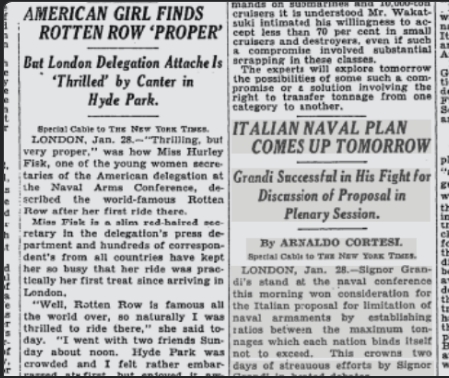
Writing as Guy Fawkes, RB notes the failure of the London Naval Conference to make waves commensurate with the attention paid to it. Correctly identifying this supposed sea lane to everlasting world peace as yet another smug salvo in the USA and UK’s effort to maintain maritime supremacy at discount prices, the author chides the New York papers for sending half their collective staffs across the pond just to make wild, quasi-official-sounding guesses at the kinds of terms the talks might produce. Less dangerously, but more obnoxiously, the media’s thirst for naval-tinged news had led to the publication of pieces like the NY Times item clipped above, in which conference secretarial staff member Hurley Fisk’s impressions of London greenspaces were deemed page 3-worthy.


Fawkes looks more favorably upon The World’s deadpan daily dispatches from a Conference clearly headed nowhere, and not even nowhere fast. Nevertheless, with hundreds of pages to fill every day, the city’s sheets couldn’t help but cover a few matters of actual import. The Hearst papers, we hear, actually bucked the transatlantic trend, preferring to spotlight a home front hot war between telephone service providers. More civic mindedly, The Telegram took Harvard College to task over its vile treatment of its custodial workers, and The World did its best to tamp down the NYPD’s truncheons in its true blue zeal to take capital’s side against “reds”.


On the other hand, The World also appeared to be developing a very bad habit of printing their front page headlines verbatim from various Hollywood studio publicity dispatches – and the soon-to-be-defunct paper baffled Benchley by “revealing” that poet Edna St. Vincent Millay had once published articles under the pseudonym Nancy Boyd, about 5 years after the last person who cared about this transparent literary imposture had forgotten all about it.

Favourite moment:
“The big excitement in the newspaper offices during the past month has been the Naval Conference in London. The excitement did not spread. [NYC Fire] Chief Kenlon, at a late hour last night, gave out the statement that it was now confined to a small corner of the newspaper offices and that, by tomorrow, the department expects to have the whole thing out and wet down.”

“After 3 A.M.” (E9)

  • Originally printed: The New Yorker, July 17, 1926
  • First reprinted in: Never Reprinted
  • Original Byline: Robert Benchley

🦉🦉

Commentary:
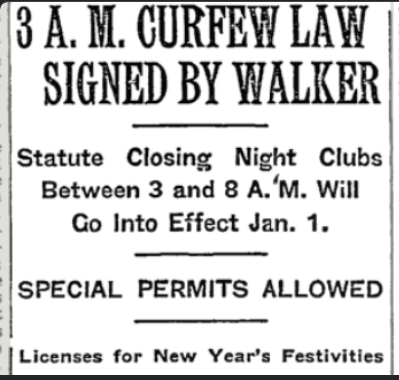
A rather slight half-page piece mocking a municipal law proposed by the Walker administration. The ordinance did in fact make it onto the books for 1927 (see below Times clipping), so Benchley’s screwball itinerary for New Yorkers who have no intention of going home until the office buildings open may very well have come in handy. For nocturnal New Yorkers bent on making their own pre-auroral fun, there was always the Columbia Storage Warehouse, the Weather Bureau station overlooking the Battery, the Eleventh Avenue steam train, and the Aquarium. Only dullards and out of towners turn in at three, in spite of Jimmy Walker’s machinations!

Favourite moment:
“Here [the weather station] there is fun indeed for all! The charts, the indicators, the thermometers and barometers, all conspire to keep guests in a fever of excitement until the little hand on the chronometer indicates that dawn is approaching.”


“After the Deluge” (E8)

  • Originally printed: The New Yorker, March 25, 1933
  • First reprinted in: Never Reprinted (for practical purposes)
  • Original Byline: Guy Fawkes

🦉🦉🦉🦉

Commentary:
Writing in his Guy Fawkes persona, RB catches up with the New York papers as they struggle (and fail) to produce coherent coverage of the Banking Crisis of March 1933, often described (in retrospect) as the absolute nadir of the Depression.


The piece begins with a blanket statement on the Press’s subservient role vis-à-vis the government. This was all well and good, Fawkes says, from the point of view of efficiency, during the summer of 1917, when the Wilson government knew exactly what they wanted in the headlines (and what they’d throw you in jail for saying against the War Effort). When Robert Benchley references the July 4th holiday (the day the family learned that beloved eldest son Edmund had been killed in the Spanish-American War), you know he’s got some skin in the game… and when he yokes those comments to militaristic misadventures, you know he’s boiling! So… the Press stands ready to reinforce norms and manufacture consent, but what happens when the patriotic puppeteers lose the plot? During the first few days of March, the New York papers were presenting financial ruin as a minor problem affecting OTHER states (and the middle strata of the newspaper). Certainly nothing to get up a headline about.


Roosevelt’s March 4th inauguration, and the passage of the Emergency Banking Act, triggered a truly dizzying week of pronouncements and retractions from all of the city’s most trusted organs. Without any point of view to sell, these ink merchants opted for perpetual motion in lieu of “spin”. Hey, it helps to calm babies. Ultimately, Fawkes concludes, the city’s opinion leaders may have meant well, but there’s no way they did any good. He adds: “It might have been well if they had placed a moratorium on newspapers during that crucial period.”


The lengthy column goes on to ask whether the press will come down on “FR” or “FD” as their shorthand term for Franklin Delano Roosevelt (apparently no one had yet thought to go “TR” one letter better – but this would come shortly!) Fawkes also glances across the ocean to take in the London Daily Express’ errant coverage of February’s abortive pre-inauguration assassination attempt. The Express appears to have gotten the wrong Florida woman on the phone and then just allowed her to take solo credit for saving FDR’s life. He hopes a similar mistake in a more sensitive matter of international diplomacy won’t create a transatlantic incident someday. Finally, Fawkes tosses a rare bouquet the New York Times’ way for sending a competent progressive reporter to cover the ongoing travesty of the Scottsboro trials – and from a quick perusal of the copy he sent back, F. Raymond Daniell does appear to have done his best to ensure that justice was properly served (of course, that would have to wait until 2013).


Despite a lifelong love of Benchley’s humour, I had actually never read a Wayward Press column before. Terrific stuff – really looking forward to the rest of them!

Favourite Moment:

“What acute stage was that? What Depression? Certainly not the ‘protective action’ in roughly two thirds of the country’s banks announced on page 19?”